What Does Document Integrity Mean?
Document integrity is the guarantee that a document hasn't been altered since its creation. Understand the concept, how it differs from authenticity, and how it's technically proven.
Attestify
Author
What Does Document Integrity Mean?
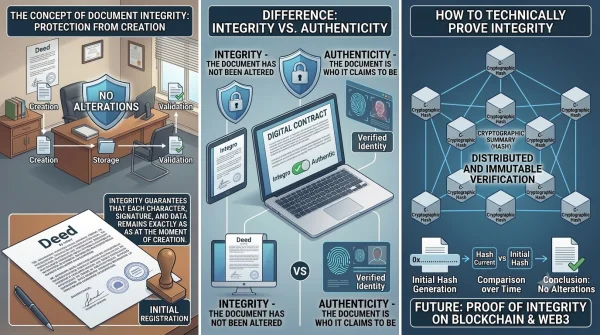
Document integrity is the guarantee that a document's content stays exactly the same from beginning to end — no additions, removals, or unauthorized changes. An intact document is one that remains, byte for byte, the same file it was when originally created or signed.
It's a different — but complementary — concept from authenticity. A document can be authentic (it really did come from who it claims) and still lose its integrity if it's altered afterward. And the reverse is also true: a document can perfectly retain its integrity while still having been fake from the start.
Why integrity matters as much as authorship
Imagine a fee agreement signed by two parties. Months later, one of them claims a clause was changed after signing. If there's no way to prove the file stayed unchanged, it's one party's word against the other's — exactly the kind of dispute that ends up in court.
Document integrity is what prevents that scenario. It answers a very specific question: is this document, in its current state, the same one that existed at that moment?
This is particularly critical for:
- Fee agreements, NDAs, and out-of-court settlements, where a single altered clause can change the entire meaning of the agreement.
- Property inspection reports, where integrity proves the actual condition of a property on the inspection date.
- Internal company policies, where integrity proves exactly which version an employee received — a requirement, among other things, of many data protection laws.
How integrity is technically proven
The most reliable way to prove integrity isn't storing a document "somewhere safe" — it's generating mathematical proof of its exact content. The most widely used method today is cryptographic hashing, usually with the SHA-256 algorithm.
A hash works like a fingerprint: a unique code generated from the file's entire content. The properties that make this useful:
- Deterministic: the same file always produces the same hash.
- Sensitive to any change: altering a single comma in the document produces a completely different hash, with no resemblance to the previous one.
- Irreversible: it's impossible to reconstruct the original document from the hash — it only serves for comparison, never exposing the content.
For this proof of integrity to actually be useful, the hash needs to be recorded somewhere no one can change afterward — not even the person who registered it. That's where blockchain comes in: by writing the hash to a smart contract, it becomes public, immutable, and auditable by anyone, with a verifiable timestamp.
A second, complementary layer of security is the RFC 3161 timestamp (ISO/IEC 18014 standard), issued by an external certification authority. It cryptographically signs the hash together with the date and time, functioning as a second independent proof — verifiable even offline, via OpenSSL.
Integrity without these proofs is fragile
Keeping a PDF in a folder on your computer, in an email, or in an internal system doesn't guarantee integrity: anyone with access can edit the file, and nothing prevents its modification date from being tampered with. File metadata (like "created on" or "modified on") is easily altered and won't hold up as proof in a serious dispute.
The difference between "I don't think I touched that file" and "I have public, mathematical proof this file hasn't changed since that date" is exactly the difference between an argument and evidence.
How this works in practice
Document registration platforms like Attestify automate this process: the SHA-256 hash is generated directly in the user's browser (the original file never leaves the device), registered on the Polygon blockchain, and complemented by an RFC 3161 timestamp from FreeTSA. The result is a certificate with a QR code that anyone can use to confirm, at any time, that a specific document has retained its integrity — with legal validity recognized.
In summary
Document integrity isn't a feeling of trust — it's a property that can and should be technically proven. Whenever a document carries legal, financial, or contractual weight, it's worth registering proof of integrity at the moment of its creation, rather than simply trusting that "no one will touch it."
Experimente o Attestify gratuitamente
Registre seus primeiros documentos na blockchain sem custo. Sem cartão de crédito.
Começar grátis