What Is Document Verification?
Understand what document verification is, why it matters, and how technology — from notary signatures to blockchain — has changed the way we prove a document is real.
Attestify
Author
What Is Document Verification?
Document verification is the process of confirming that a document is genuine, that it belongs to whoever it claims to belong to, and that it hasn't been altered since it was created or signed. It sounds simple, but it's the foundation of almost every formal trust relationship: a contract, a diploma, a report, an invoice, an employment agreement.
Whenever someone asks "is this document actually real?", they're effectively asking for verification. The answer to that question can be worth a lawsuit, a closed deal, or a fraud avoided.
Why documents need to be verified
Documents exist to record facts and commitments. But paper can be forged, PDFs can be edited, and even simple digital signatures can be disputed. Verification exists to close that gap: it turns "trust my word" into "here's proof."
This matters especially for anyone handling documents with legal or financial weight:
- Lawyers, who need to prove a contract was signed in that exact format, on that exact date.
- Real estate agencies, who need to prove the condition of a property recorded in an inspection report.
- Companies and HR teams, who need to show that an employee received and agreed to an internal policy.
In any of these cases, document verification is what lets you defend your position when it's challenged.
The three pillars of verification
Verifying a document usually means checking three things:
- Origin — did the document actually come from who it claims to?
- Timing — did the document exist in that exact form, on that date?
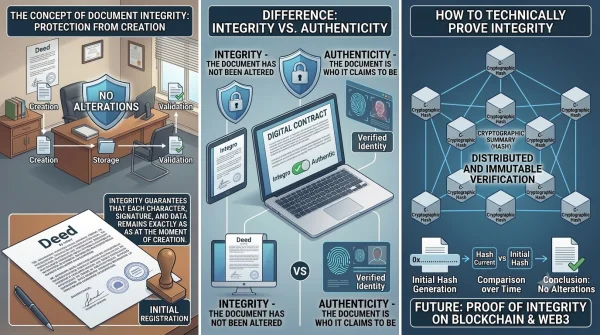
- Integrity — does the content remain exactly the same as the original, with no alteration whatsoever?
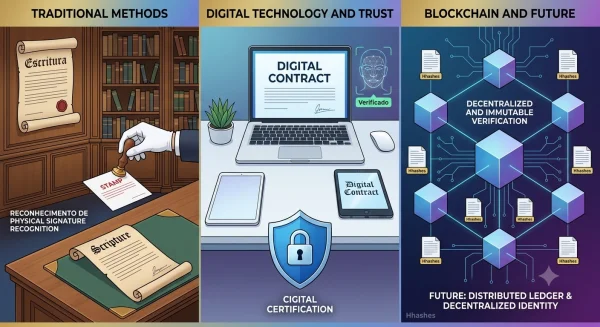
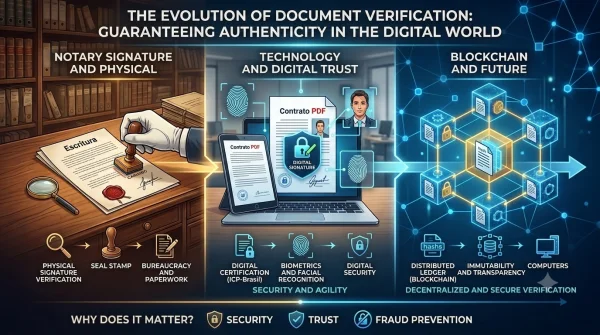
Traditional methods, like notarization, partially solve the first point, but they rely on paperwork, cost, and trusting a third party (the notary) who keeps the record on paper or in a closed system.
How technology changed verification
Modern digital verification solves all three pillars at once, mathematically. The most common path today is:
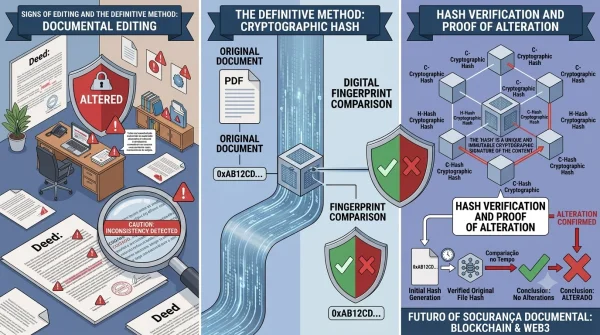
- Generate a cryptographic fingerprint of the file (a hash, usually SHA-256) — a unique code that changes completely if even a single character of the document is altered.
- Record that hash somewhere no one — not even whoever registered it — can erase or modify afterward. That's where blockchain comes in: the hash is written to a smart contract, with a public, auditable timestamp.
- Add an independent timestamp, such as the international RFC 3161 standard, signed by an external authority. That way, there are two separate proofs of the document's existence at that moment — if one fails, the other still holds.
The result is a verification anyone can perform on their own, without asking anyone's permission: just compare the hash of the file in hand with the registered hash. If they match, the document is exactly the one that was registered, without a single comma changed.
Verification is not the same as signing
It's worth drawing a distinction: signing a document (even digitally) is expressing agreement with its content. Verifying is confirming that this content, with that signature, is genuine and hasn't been tampered with afterward. These are complementary processes — a document can be signed and still be disputed if there's no way to prove it wasn't altered after signing.
That's why services like Attestify don't replace signing — they protect it: by registering a document's hash on the Polygon blockchain with an RFC 3161 timestamp, anyone can publicly verify, without an account, that a specific file existed in that exact form on that date — with legal validity recognized.
In summary
Document verification is the mechanism that turns a claim ("this is true") into proof anyone can check. The more that verification depends on trusting a single intermediary, the weaker it is. The more it relies on public, immutable mathematical proof, the stronger it becomes — which is why cryptography and blockchain have been increasingly adopted in everyday legal and business practice.
Experimente o Attestify gratuitamente
Registre seus primeiros documentos na blockchain sem custo. Sem cartão de crédito.
Começar grátis